Home / Blog Details
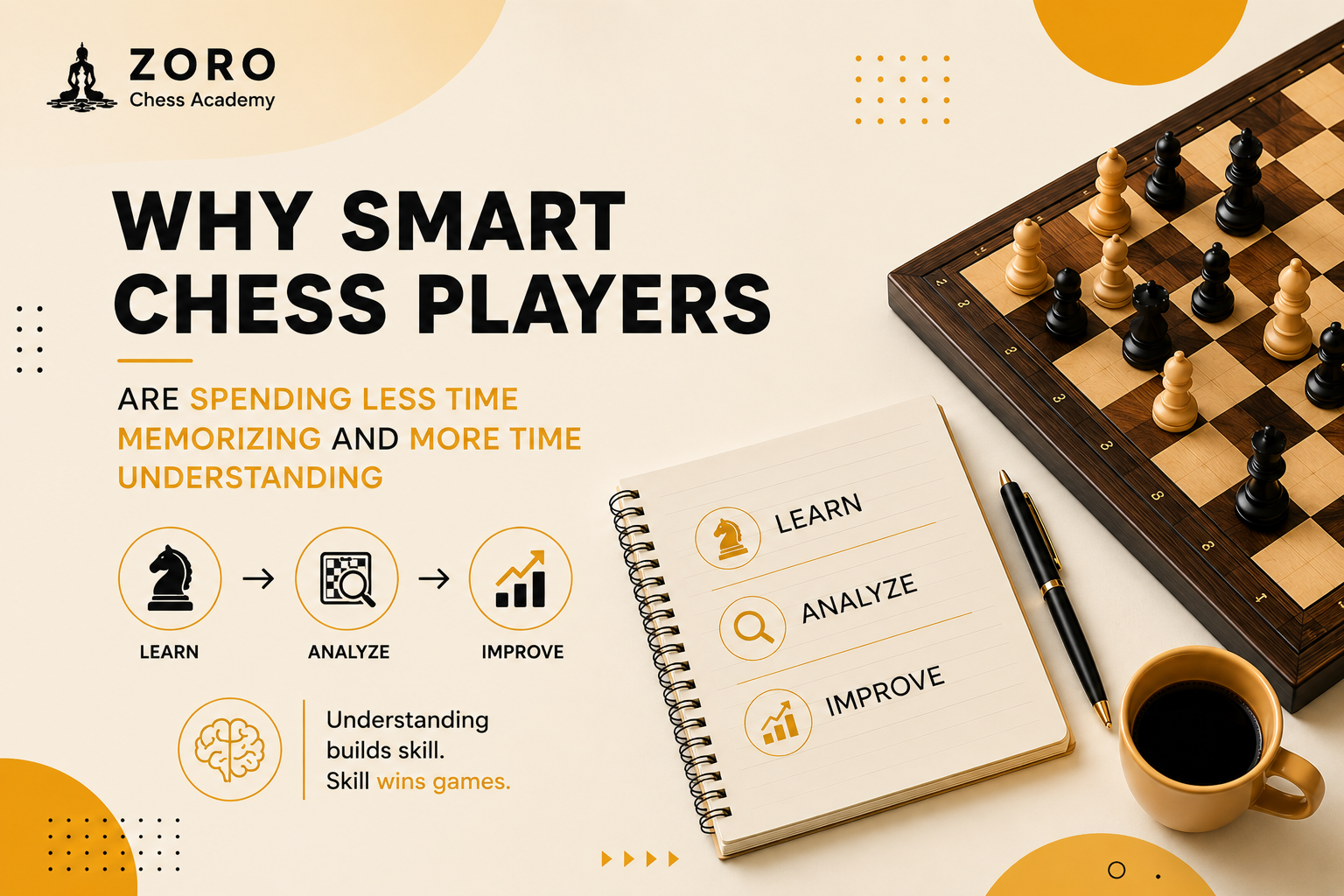
For a long time, many chess players believed that success came mainly from memorizing opening lines, famous games, and complex move sequences. While there is still a place for memorization in chess, the current trend in today's world of chess is moving toward an alternative approach to learning and playing chess. Instead of spending countless hours trying to memorize hundreds of different moves, good players spend more time thinking about and understanding the ideas behind the moves.
By focusing on understanding the fundamentals of chess rather than memorizing them, players have been improving rapidly, making good decisions when under pressure, and developing solid long-term chess skills. Beginners and experienced players alike are realizing that it is much more valuable to understand how the game is played rather than simply trying to memorize it.
Historically, chess instruction has revolved around the concept of memorizing. Chess players would spend countless hours studying opening theory alone in an effort to memorize the sequence of moves in response to the numerous different variations.
Although memorization can yield some short-term benefits, it has limitations. Players who only rely on their ability to memorize respond much more slowly time wise if their opponent plays an unusual move than if the player has to adapt to their opponent's move. Once a player goes outside their set of memorized lines within a game, the player becomes uncertain about what type of decision to make.
This is why many chess coaches and experienced players now place greater emphasis on understanding the game rather than simply memorizing moves.
The game of chess is based on thoughts, patterns, and the ability to think strategically. Every move a player makes should have a clear purpose behind it. A player's understanding of the purpose for making a particular move will allow them to have confidence in their ability to respond to any kind of position that they may be presented with during play, even if it appears unfamiliar to them.
Strong players typically aim to:
By focusing on these areas, players are able to play confidently and effectively regardless of whether they have previously seen the position.
One reason that understanding is becoming increasingly important is due to the influence of pattern recognition. Experienced chess players do not rely on memorizing every position they might encounter during a game. They simply look for common structures and themes across multiple games.
For instance, a player who understands:
will usually be able to achieve their goal of finding good moves in a certain position very quickly without having to rely on prior knowledge.
Pattern recognition develops naturally with lots of experience through actual games, analysis of previous games and through directed practice. Over time, these experienced players will identify more potential opportunities than less seasoned competition.
In recent years, greatly, the ways that chess is taught have changed. Many programs focused heavily on the memorization of games are no longer popular.
Fortunately, students are now encouraged to:
This helps players become more adaptable and confident in making decisions during competitive matches.
An effective learning environment for chess generally includes providing students with a structured approach to the curriculum that will include developing skills in each of the four broad areas of chess (openings, middlegame strategies, endgame techniques, and tactical training). As a result, students begin to understand the game as a whole rather than focusing only on single moves.
For instance, if you learned the first twenty moves of an opening perfectly, but your opponent plays a different move than expected on move six, most of your prep work is irrelevant.
This is often seen in the play of both amateur and intermediate level players.
The players who have an understanding of:
will continue to play with confidence when they reach an unfamiliar position. Understanding provides flexibility. Memorization provides dependence. The strongest players use both approaches, but they always focus on understanding first.
Tournament games do not often allow for a repeatable style of play, as every opponent has a different style of play as well as unique levels of preparedness and strategic planning.
Players who rely primarily upon memory will typically begin to feel uncomfortable when they reach the end of their prep work. Players who develop a stronger conceptual understanding will find themselves adapting to changes in the game.
Some of the benefits of this include:
Because of these reasons many coaches now emphasize teaching ideas rather than simply teaching lines of play in chess openings.
Post-game analysis is one of the best ways to increase your ability in chess.Instead of thinking, "What move did I miss?" strong players ask themselves questions like:
This approach makes learning faster by focusing on understanding instead of short-term memory.
Many players attribute their improvement to carefully reviewing mistakes that gave their opponents an advantage, rather than relying solely on memorization. These success stories show that understanding mistakes, how they were made, and learning about the principles behind making good decisions contribute greatly to long-term improvement.
With today's modern technological tools, the resources for learning and improving your game are more available than ever.
Today's players can:
Nevertheless, the greatest benefit of technology is not derived from memorizing the engines recommendations. Rather, players should strive to gain a thorough understanding of why the engine recommends certain moves.
This more profound level of learning yields stronger practical results.
A player with a complete understanding of the fundamentals will continue to develop for many years. Skills developed through understanding chess are applicable throughout every part of the game in relation to
These include:
In contrast to relying on memorized variations, the skills contained in these types of techniques will continue to offer benefits regardless of your choice of opening or your opponent’s style.
Programs aimed specifically at developing your skills typically focus on providing techniques that form the foundation for players to enhance their overall understanding of the game and build confidence when competing at various levels.
As chess education evolves, players of all abilities are beginning to favor conceptually based learning over memorizing moves. While opening preparation continues to be an integral part of chess development, players are now more focused on developing their understanding of concepts, recognizing patterns, and enhancing their analytical capabilities.
Players who improve the fastest are not necessarily those with the most moves memorized; rather they are the players who have a greater understanding of why a particular move was made than merely applying what they have memorized in any position.
Today's chess players know how much more useful it is to "know" rather than just "memorize." By using their mind to think strategically, recognize patterns, make decisions, and apply their knowledge in real-life situations, players can adapt themselves to become better on all types of playing boards, including both traditional and online. Whether you are just getting started in chess, or you're working on improving your skill level or Elo rating, putting time into understanding will yield high dividends for years to come. At ZORO CHESS, we promote solid foundational principles, develop critical thinking skills, and instill confidence by focusing on understanding versus memorization.
Although memorization has some degree of merit in chess (especially in regard to openings), understanding the rationale for certain moves is way more valuable for continued progress over time.
Learning to think strategically, reviewing your own games, evaluating tactical puzzles, and studying with experienced mentors who can explain to you why certain moves are made will help you grow as a chess player.
As a beginning player, understanding key ideas such as piece and pawn development, building control of the center of the board, and protecting your king are much more effective than trying to memorize lots of lengthy opening lines.
Recognizing common patterns allows you to quickly evaluate your current position and find the best moves available without mentally calculating out every possibility from start to finish.
The answer is usually "yes." The ability to comprehend strategic and tactical concepts also creates a player who can adapt better during actual gameplay and achieve more success in the future as opposed to relying solely on memorization techniques for improvement.