Home / Blog Details
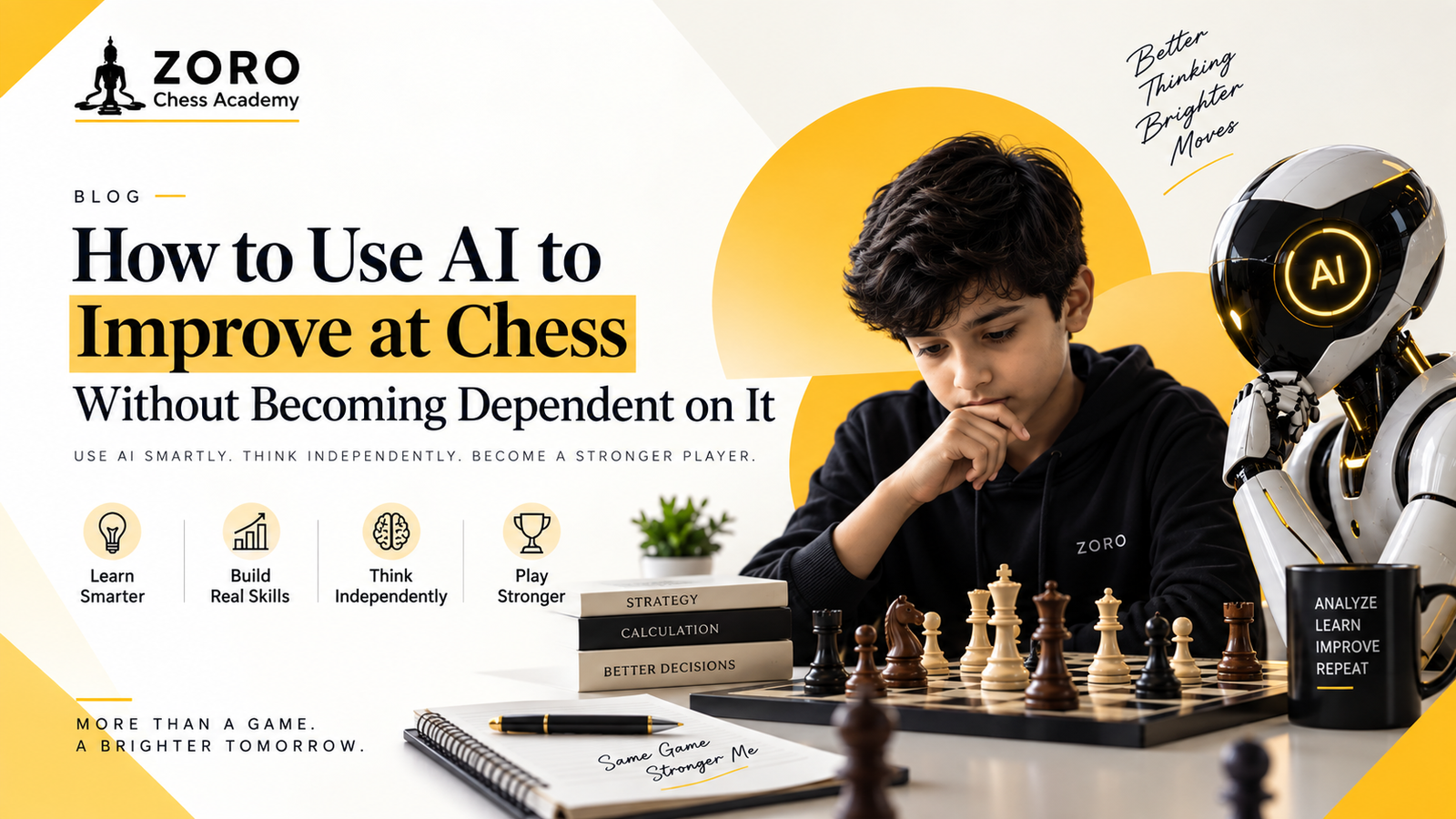
You finish a game. The result stings. Within seconds you open the analysis board. Three red squares appear. The engine shows “Best move: Nf3” or “Evaluation: +1.8.” You glance, nod, and start another game.
Did you actually improve?
Modern engines and AI tools highlight mistakes faster than any coach. Yet many players treat them like answer keys. They see what the computer preferred without understanding why their thinking failed or how to spot the same idea next time.
AI should be a training partner, not a replacement for thinking. Used well, it sharpens calculation and decision-making. Used carelessly, it weakens the skills that matter when the engine is off.
Traditional engines such as Stockfish calculate deeply and assign numerical evaluations. As of 2026, Stockfish 19 remains one of the strongest open-source engines. These tools excel at finding accurate moves but do not automatically explain ideas in human terms or diagnose habits.
AI learning systems often combine engine output with natural-language explanations, mistake categorization, pattern detection, and progress tracking. Platforms like Chess.com and Lichess offer game reviews that classify moves and highlight critical moments. An engine calculates. An AI system may organize or personalize that information. Neither replaces the mental work of understanding a position yourself.
It delivers instant feedback on tactics and inaccuracies, lets you review exact moments instead of relying on memory, and reveals recurring weaknesses such as hanging pieces, weak king safety, passive pieces, or endgame gaps. Tracking patterns over time makes practice more focused. These benefits do not guarantee faster rating gains on their own—improvement still depends on how you process and apply the information.
Checking the engine before thinking stops independent analysis. Memorizing “the engine said 18.Nf3” is less useful than understanding that the move improves king safety and challenges the center. Chasing evaluation numbers (+0.5 to +1.8) without asking what changed or why leaves the practical reason unclear. Constantly asking “What is best?” weakens decision-making under real conditions. Bots are excellent for repeating positions and testing ideas at controlled strength, but human games add different styles, time pressure, and imperfect play. Both have value; neither fully replaces the other.
A simple framework: Think → Predict → Calculate → Compare → Understand → Practice.
Instead of “What is the best move?”, ask: What is the main weakness? What tactical idea did I miss? Why is my move inferior? What candidates should I have considered? Explain this without giving the move first. Give me a similar position to solve myself.
Useful prompt: “Act as a chess coach, not an answer machine. I will share a position or PGN. First ask what I was thinking and which candidates I considered. Do not reveal the engine’s best move yet. Help me identify the issue. After I explain, compare with the evaluation in simple terms and give one training exercise based on the mistake.”
Use bots for focused skill-building. Use human games for realistic competitive experience. Engines provide speed and consistency; a human coach supplies context, prioritization, and accountability. The strongest model combines independent thinking, AI analysis, and guided coaching.
Parents should encourage children to explain their moves before checking any engine, review critical moments together, and treat AI feedback as material to discuss rather than final answers.
You cannot explain why the engine’s move is good. You open analysis before thinking. You memorize lines without understanding. You feel uneasy when your evaluation differs. You rarely analyze without help. You focus more on accuracy percentages than concepts.
If several apply, change how you use AI rather than abandoning it.
Analyze one game a week completely without an engine. Always list candidates first. Spend two minutes evaluating material, king safety, activity, structure, threats, and plans. After seeing the engine move, restate the reason in your own words. Keep a short mistake journal.
The real test is not whether you find the right answer with help. It is whether you make better decisions when the engine is turned off. The goal is not to become better at using an engine. The goal is to become better at chess.
Zoro Chess Academy combines structured curriculum, personalized coaching, and technology that connects with Lichess and Chess.com accounts to track games, analyze moves, and generate progress reports. Technology surfaces data; coaching turns it into a coherent plan focused on calculation, strategic thinking, and decision-making.
AI can reveal mistakes, explain positions, and highlight patterns. You still need to think, calculate, evaluate, decide, and learn from errors independently. Use AI to show what you missed. Use your thinking to understand why. Then train until you recognize it yourself.
FAQs
Can AI help me improve? Yes—when it verifies your analysis and creates targeted practice rather than supplying unearned answers.
Should I check Stockfish after every game? First analyze yourself and identify critical moments, then use the engine.
Can AI replace a coach? No. The combination of independent work, AI tools, and human guidance is strongest.
How do I avoid dependence? Analyze first, ask “why,” explain ideas yourself, and practice regularly without assistance.
Are bots useful? Yes for controlled practice. Human games remain essential for real decision-making.