Home / Blog Details
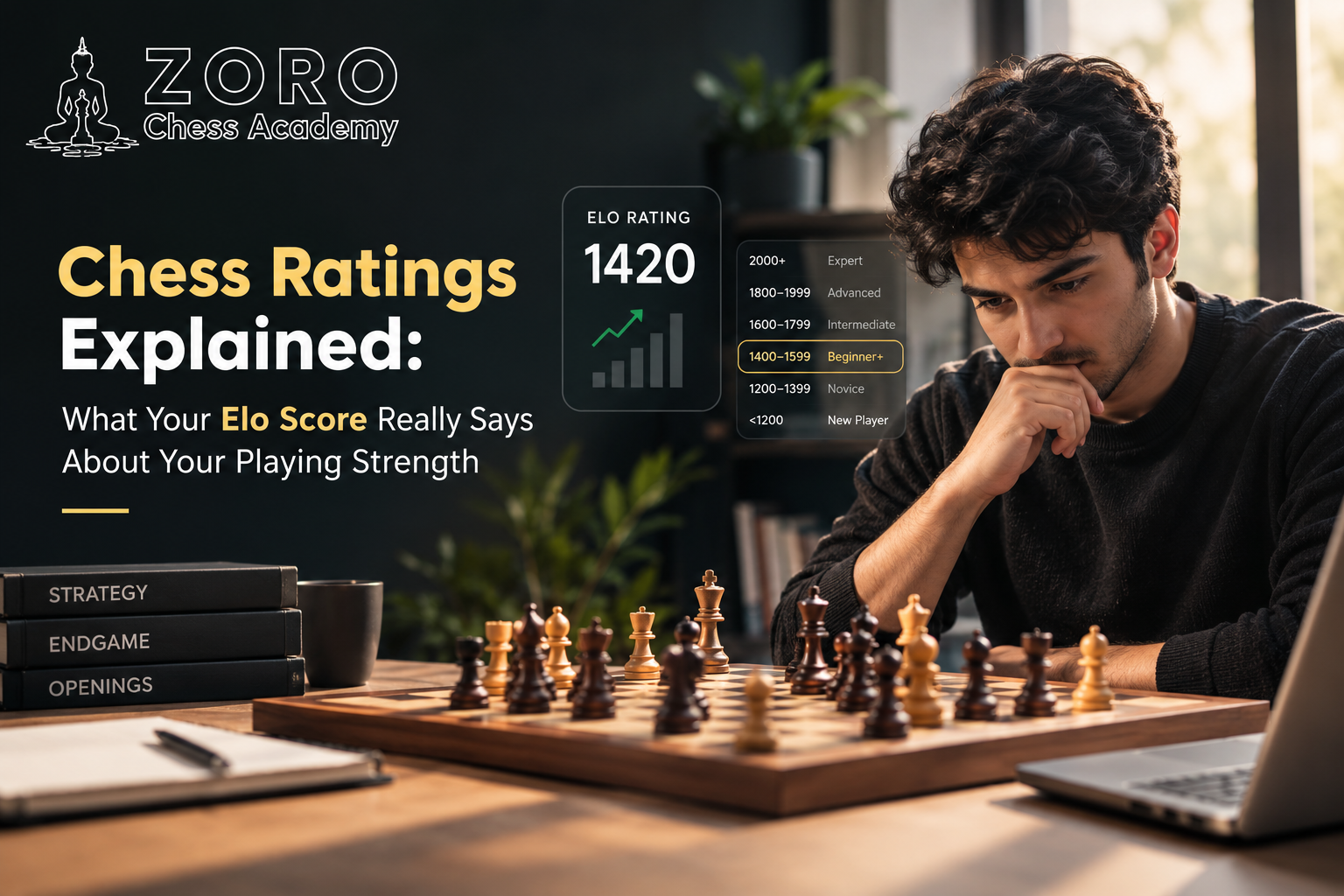
Have you ever won several chess games but noticed that your rating barely changed? Or lost against a lower-rated opponent and wondered why your score dropped? These situations are common among chess players learning how rating systems work.
A chess rating is not simply a reward for winning. It estimates your playing strength based on results against other rated players. Understanding what influences your score can help you recognise weaknesses, measure progress and improve strategically.
Let's explore what your chess Elo rating means, how it changes and what matters beyond the number.
The Elo rating system is a mathematical method for estimating the relative playing strength of competitors. Developed by physics professor and chess player Arpad Elo, it is used in chess rating systems.
The International Chess Federation (FIDE) uses an Elo-based system for eligible competitive chess performances. Your rating reflects how your results compare with the outcomes expected against opponents with known ratings.
For example, two players may know the same opening variations but perform differently under tournament pressure. Their ratings reflect competitive results rather than simply their theoretical knowledge.
A higher rating generally indicates stronger performance within the same rating pool. However, it does not guarantee victory in every game.
Your rating changes according to the difference between your actual result and the result expected by the rating system.
Three factors influence this calculation:
Imagine a player rated 1500 competing against an opponent rated 1600. The lower-rated player has an expected score of approximately 0.36.
If that player wins, an illustrative calculation using a K-factor of 20 is:
Rating change = K × (Actual score − Expected score)
20 × (1 − 0.36) = 12.8 points
This demonstrates why winning against a stronger opponent can positively affect your rating. Actual FIDE calculations depend on applicable regulations, including the player's K-factor and results during the rating period. This example illustrates one game's contribution, not a guaranteed published increase of 13 points.
For more details, refer to the official FIDE Rating Regulations.
A rating difference does not reveal everything about how two players approach chess.
One player might have excellent tactical awareness but struggle with endgames. Another might understand positional play but occasionally miss simple combinations. Both could have similar ratings despite different strengths and weaknesses.
Instead of focusing only on your score, consider whether you can:
These abilities help explain what your rating alone cannot show.
FIDE and Chess.com use different rating methodologies and player populations, so their ratings are not directly interchangeable.
FIDE ratings: FIDE uses an Elo-based system for eligible rated competitions, following its official rating regulations.
Chess.com ratings: Chess.com uses the Glicko rating system, which considers rating uncertainty alongside performance. This can influence how much your rating changes after a game.
Ratings can also differ between Rapid, Blitz and Bullet because each time control creates a different competitive environment.
Compare your progress within the same platform and time control rather than assuming that an online rating equals the same numerical FIDE rating. Read Chess.com's explanation of its rating system.
Rating changes become easier to understand when you consider the expected result behind each game.
A rating drop does not automatically mean your chess ability has declined. Time pressure, unfamiliar positions and avoidable mistakes can affect individual results.
Your rating reflects results, but reviewing your decisions helps explain why those results happened.
After a game, ask yourself:
This approach turns every game into a learning opportunity, regardless of the result.
Improvement becomes more consistent when you practise with a clear purpose instead of playing continuously without reviewing mistakes.
The objective is not just to increase the number beside your name. It is to improve the decisions that influence your results.
There is no universal rating that defines a good beginner. FIDE and online platforms have different rating scales. Focus on fundamental principles, avoiding simple mistakes and developing consistent playing habits.
A higher rating generally indicates stronger performance within the same rating pool. However, it does not guarantee a win in every game or equal ability across all time controls.
FIDE uses an Elo-based system, while Chess.com uses Glicko. Their methods, player populations and competitive environments differ, so their scores are not directly interchangeable.
Practise tactics, review completed games, understand opening principles and strengthen your endgame knowledge. Correcting repeated mistakes is more valuable than playing without analysing your performance.
Structured coaching can help identify weaknesses, explain strategic concepts and create a focused practice routine. Regular feedback can also reveal mistakes you might overlook during independent practice.
Your chess rating helps measure competitive progress, but it should never become the only measure of your ability. Learning from mistakes, making purposeful decisions and understanding different positions are equally important.
At Zoro Chess Academy, structured learning, personalised guidance, game analysis and progress tracking help students develop their chess skills with clear learning goals. With consistent practice and the right guidance, players can build stronger fundamentals and become more confident competitors.
Your rating shows where your results stand today. Your learning habits help shape where your chess can go tomorrow.